
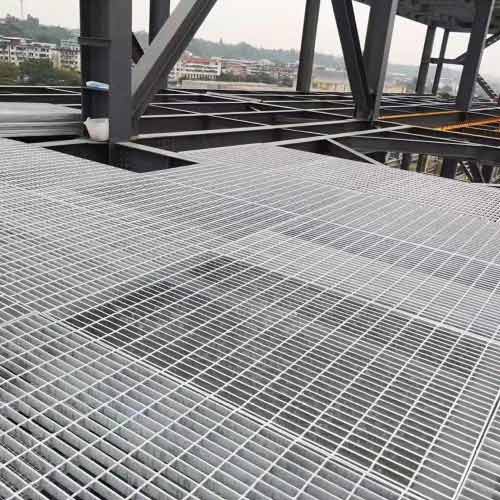
Platform grating, a robust flooring solution made of interwoven metal bars, is ubiquitous in industrial settings such as oil rigs, factories, and power plants. Its open-grid design ensures slip resistance, drainage, and ventilation, making it ideal for elevated walkways, machinery platforms, and stair treads. Proper installation is critical to harness its benefits while mitigating risks like tripping or structural failure, necessitating adherence to industrial best practices and safety protocols.
Pre-installation planning starts with assessing site conditions and load requirements. Engineers evaluate environmental factors: corrosive chemicals in chemical plants demand stainless steel grating, while offshore platforms require galvanized steel to resist saltwater. Load calculations determine bar spacing (typically 19–38 mm) and thickness (6–12 mm), balancing weight capacity (live loads up to 5 kN/m2 for pedestrian areas, 10–20 kN/m2 for equipment zones) with material efficiency. Site surveys check for obstructions (piping, wiring) and ensure the substructure (steel beams or concrete slabs) is level and capable of supporting the grating’s dead load plus live loads.
Surface preparation and alignment are foundational steps. The substructure is cleaned of rust, debris, and loose coatings, then primed to prevent corrosion at contact points. Using laser levels or string lines, installers mark reference points to ensure the grating sits flush and level. For large platforms, modular panels are pre-cut to size (accounting for expansion gaps of 3–5 mm per linear meter) to minimize on-site adjustments. Temporary supports or clamps hold panels in place during fixing, preventing displacement.
Fixing techniques vary by application but prioritize secure anchorage. Welding is common for permanent installations: panels are welded to steel substructures at intervals of 300–500 mm, using fillet welds to distribute stress evenly. For non-permanent or corrosive environments, mechanical fasteners (stainless steel bolts with lock washers) are preferred, allowing easy removal for maintenance. Clips or saddle brackets secure grating to concrete via expansion anchors, ensuring vibration resistance in machinery areas. Installers must avoid over-tightening fasteners, which can warp panels, and ensure all fixings are corrosion-resistant to match the grating material.
Safety measures permeate every installation phase. Workers wear non-slip footwear, harnesses, and gloves, with fall protection systems (guardrails, safety nets) mandatory for heights over 2 meters. During welding, fume extractors and fire blankets mitigate hazards, while mechanical fixing requires checking torque values to prevent loosening under dynamic loads. Post-installation, edges are deburred to remove sharp protrusions, and anti-slip nosing is added to stair treads. Load tests simulate real-world conditions (e.g., concentrated loads from forklifts) to validate structural integrity, with any deflection exceeding 1/200 of the span triggering reinforcement.
Industrial applications of platform grating underscore its versatility. In petrochemical plants, it provides safe access to reactors and valves, with corrosion-resistant grades enduring harsh chemicals. Power plants use it for turbine platforms, where its heat resistance and load capacity handle heavy equipment. Warehouses deploy it for mezzanine floors, maximizing vertical space while allowing light and air circulation. By combining durable materials, precise installation, and stringent safety practices, platform grating enhances operational efficiency and worker safety across industries.
-
2026-03-13When engineers design access platforms around cylindrical structures—such as silos, reactors, or storage tanks—the circular platform grating becomes an indispensable solution for safe, ergonomic, and code-compliant walkways. Unlike flat panels that leave awkward gaps, custom-fabricated c
-
2026-03-12Cast iron grating has served as the foundation of drainage systems for centuries, providing the robust, reliable surface drainage that handles pedestrian and vehicular traffic in urban environments worldwide. These cast metal components feature perforated or slotted patterns that allow wat
-
2026-03-11Industrial HVAC systems require stable and safe maintenance access platforms to support personnel and equipment. Chiller platform grating serves as the critical flooring surface for these elevated structures, providing a non-slip and durable working environment. Chillers are typically heav